
We are very excited to announce that our very first highlighted collection of the year is from the Royal College of Physicians! Find out more in this new blog post by Katie Birkwood (Rare Books and Special Collections Librarian) which features the amazing Heritage Library and their incredible collections.
I’m Katie Birkwood, the rare books and special collections librarian at the Royal College of Physicians (RCP). I have the great delight to care for the college’s collection of rare books, amassed over 500 years of collecting.
The RCP is England’s oldest medical royal college, based in joint headquarters in London and Liverpool. Founded in 1518 by Henry VIII, it once had the legal powers to license medical practitioners. Today it’s a membership association with around 40,000 members worldwide, which supports physicians throughout their careers, influences healthcare policy, and works to improve medical care. Membership of the college ranges from medical students to senior consultants, mostly working in hospital-based medical specialties such as cardiology, neurology, rheumatology, and around 30 other areas of medicine.
The RCP runs two distinct but collaborative library services to meet the needs of different audiences:
- The RCP Library provides a primarily online library service to support members and RCP students with their professional development and educational goals. Its services include literature searching, document delivery, and access to eresources via OvidDS, Trip Pro and the Read app. It also administers inter-library loans to other institutions.
- The Heritage Library preserves over 500-years of book collecting history at the college, as well as maintaining a library of contemporary works relating to the history of medicine and to inform the understanding of RCP history. It works in partnership with the RCP archives and museum to provide free research access to the collections to all interested readers, to organise public events, and to interpret RCP history and collections to online audiences.
As rare books and special collections librarian, I manage every aspect of the heritage library, from assessing and accessioning new donations and book purchases, to cataloguing, answering enquiries, supporting researchers using the collection, managing conservation work, writing about the books for social media, curating displays and exhibitions, leading tours of the RCP historic collections, supervising volunteers and interns, and more besides.
Though it’s part of a medical institution, the heritage library contains books on many subjects well beyond the bounds of medicine alone. The collections grew over time mainly through donations from fellows of the college, and those fellows were expected to be ‘Groundely lerned’: knowledgeable about all areas of enquiry. The books we care for today therefore reflect their wide interests and the social history of the times in which they lived.
The mathematical sciences broadly conceived are well represented, with works on geometry, astronomy, astrology, architecture and military engineering appearing frequently. John Babington’s Discourse of artificiall fireworks (1635) combines the serious science of explosives and ballistics with the drama and beauty of firework displays. Luxury dining turns up as a subject in another lavishly-illustrated 17th-cenutry book: Georg Philipp Harsdörffer’s Vollstandiges und von neuem vermehrtes Trincir-Buch (1657) includes detailed instructions on how to carve every conceivable joint of meat, and how to decorate your dining table.
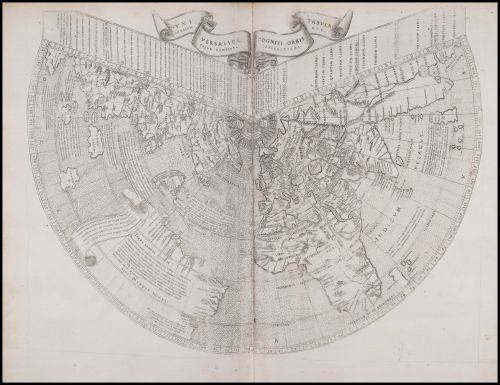
Much of the book collection was assembled during the height of European colonialist expansionism, and that is reflected in the books’ contents in many ways. Beautiful geographical works such as the 1508 edition of Ptolemy’s Geographiae trace the progress of the European settlement of the American continents.
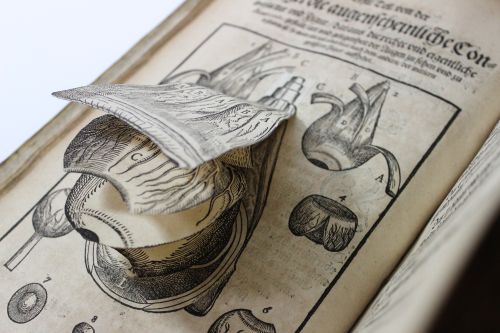
But that’s not to say that the medical collections aren’t also very impressive. As well as a wide collection of the textbooks that physicians past used to study for their exams, we have all the expected anatomical works. What really catches my eye, however, are the spectacular anatomical flap books which use lifting layers of paper to reveal the body’s inner workings to specialist and general audiences alike.
I’ve gradually been working on improving our understanding – and documentation – of the history of the library: when, and from whom, the books were acquired. This information wasn’t always systematically recorded in the past, but can often be reconstructed from archival documents and evidence in the books themselves.
Our most prestigious ‘collection within the collection’ is the largest surviving set of books previously owned by the Elizabeth mathematician and mystic John Dee (1527 –1609). The numerous annotations in those books have made them the subject of books, an exhibition, digitisation projects, and ongoing study. It still stops me in my tracks to know I’m holding a book that was studied and commented on by such a famous and intriguing figure nearly 500 years ago.
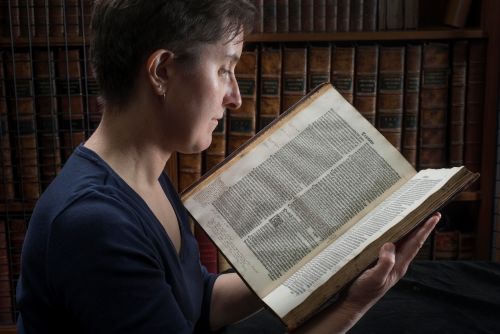
Less famous figures also figure in the research undertaken in the library. Over the last few years we have been host to a doctoral research project funded by the London Arts and Humanities Partnership, and pursued by student Catherine James. Catherine’s research has seen her survey all of the pre-1714 books in our historic library space (approximately 7,000 volumes) to look for evidence of women’s book ownership and use. It’s exciting to see her begin to write up her findings, and to express them in innovative outputs such as the current art installation ‘Making Visible’.
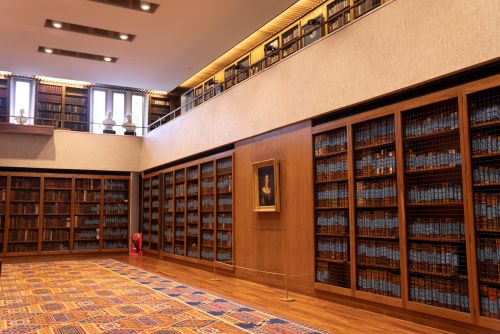
The history of the Royal College of Physicians’ library is the subject of the current temporary exhibition ‘A body of knowledge’, on display until 23 July 2026 at the RCP at Regent’s Park, London, and online. The exhibition explores 500 years of book collecting at the college, highlighting the range of materials in the library, the individuals who contributed to its creation, and the beauty and craft of book-making technologies. In it you can see some of my favourite books from the library: both famous and lesser-known.
We have a varied programme of events to accompany the exhibition including talks, workshops and tours: keep an eye on our events page or our social media (@RCPmuseum) for more information.
By Katie Birkwood – Royal College of Physicians Library
You can explore the library’s collections on Discover and find further contact details on their Discover information page.
All images copyright of the Royal College of Physicians, reproduced with kind permission of the copyright holder.
